Videos in Less Pain Chinese

显示标签为“Pinyin”的博文。显示所有博文

2/02/2009

Pinyin-summary

I think it is useful to collect those posts about Pinyin in a single post and put it under the 'useful posts'.
It is reasonable to know why you may want to study Pinyin, when there are alternative solutions to the phonetic system of Mandarin. This brief introduction may give you some feeling.
You can go over the 3 components of Pinyin in more detail with our hints and audio file.
Initials:
b p m f
d t n l
g k h
g q x
z c s
zh ch sh r y w
Finals:
All finals are integrated in this post.
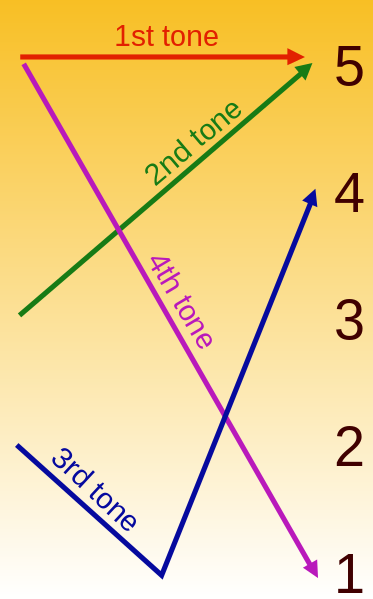
Tones:
In standard Mandarin, there are only 4 of them, so not that hard.
Be a bit careful that the following may sound a little beyond your expectation when they are combined together:
zhi chi shi ri zi ci si
Now all you have to do is just to link them together, and practice, practice and practice! I will post the pinyin for dialogues and words soon, you just try your best to mimic. This tool is useful and you can listen to the standard pronunciation of those characters that you are not sure about.
Read more...

1/22/2009

Pinyin-Link them together!

Now we already learned 'Initials', 'Finals' and 'Tones', it is time for us to combine these 3 things and speak Chinese out!
Question: Can you try to pronounce 'nǐ hǎo' and 'zài jiàn'?

nǐ hǎo =Hello!=How are you doing?
zài jiàn=Bye!=See you!

I would like to highly recommend you go to this site to practise all these combinations. Just by clicking THREE parts you can listen to the standard pronunciation:


For example, if you want to hear what nǐ sounds like, then:
1. Click 'n' under initials;
2. Click 'i' under finals;
3. Click '3rd' in tones.

CC's note:
1. One 'problem' for newcomes of Pinyin is that they feel a little frustrated when it comes to this part to combine initials and finals since some initials do NOT go along with some finals. Well, please relax!!! This is not a rule for you to learn by rote, nor to confuse you.


2. Another good feature of the above page is that you can find out what combinations are valid or not, which are differentiated by bold and shaded fonts. By speaking instead of merely memorizing lots of times, I think it would be natural for you to see which initial and final are a good match.

3. The following syllables may sound a bit beyond your expectation:

zhi chi shi ri zi ci si

For example, 'shi' does NOT sound like 'she' (in English), when you try to combine 'sh' and 'i'.

You are welcome to experiment and then correct your own pronunciation as much as possible. Anyway, please practise!


Read more...

Pinyin-tone

Writing does not help too much here, so I will keep it simple:

1. 4 tones in Standard Mandarin:


2. It's something like this:

Read more...

Pinyin-Finals

Today, let's just finish all finals and end the seemingly boring foundation lecture before the Chinese new year (In the 'Chinese Calander' on the right, it begins on 26th, Jan.)!

There are more finals than initials and they seem to be more messy, but I decide to list all of them in this single post so that you can keep checking them back. I think after the excercise from initials you should be a bit familiar with the Pinyin Phonetic system and be aware of its difference from English. Smilarly, what you need to do again is just:

Listen->Mimic->Practice->Correct

Hopefully before Chinese new year we can learn some simple greetings based on this Pinyin system. So now let's check them out one by one:

a o e i u ü
--These 6 are the basics. The following can be regarded as combinations of them.

ai ei ao ou

--Take 'ai' for example, it's just combining the pronunciation of 'a' and 'i', try that out, do you make it?

ia ie ua uo ue(üe)

iao iou uai uei

--It appears to be complicated, but it's nothing but combination! For instance, iao=i+ao, right?:)

an ian uan üan

en in un ün

ang iang uang ong

eng ing ueng iong

In order not to scare you guys away, I will simply link you to Wiki for the tips of pronouncing finals.
Read more...

1/18/2009

Pinyin-Initial-zh ch sh r y w

zh ch sh r
Now we are about to finish all the initials, and this group is also pretty special since some of them seldom (actually to my knowledge, NEVER) appear in English as par of normal words, say, zh. And for ch, sh and r, the way to pronounce is totally different. So you are encouraged to get some feeling of them here.
To pronounce these 4 sounds correctly, you need to curl you tongue. And the with the following tips you can get there.
zh: Like the 'dr' in 'drink'.
ch: Similar to the 'ch' in 'Chinese'. Notice, not exactly the same! Curl your tongue a little bit!
sh: Similar to the 'sh' in 'shoot'. Again, culr your tongue:)
r: Similar to the 'r' in 'rain'.


y w
No surprise, they just sound like the letters y and w as in English:
y: Like the 'y' in 'yes'.

w: Like the 'w' in ''we.

CC's Note:
1. These 4 sounds are retroflexed, so make sure you feel your tongue curled when you read them.
2. For r, please be noted that in English when you pronounce something like rain, your tongue is hung in your mouth without touching anywhere inside. But to pronounce the Pinyin r, you just make the front surface of your tongue close to the roof of your mouth, as well as the curling advice.


Read more...

1/17/2009

Pinyin-Initial-z c s

z c s
This group also deserves some notice in the sense you want to differentiate (especially) z and c from their pronunciation in English. You can try to listen to them here and compare the differences.
z: Like the 'ds' in 'woods'.
c: Like the 't's' in 'That's great!'. Compared to z, c is more aspirated.
s: Similar to the 's' in 'speak' as in English.

CC's Note:
For z, do not confuse it with the 'z' in 'zoo'.
For c, do not make the 'k' sound as in cat, capital and so on.
Read more...

Pinyin-Initial-j q x

j q x
Though appeared in English, these three may sound the most different in Pinyin. Anyway, please check out their pronunciation here.

To well pronounce them, please be noted to put your tongue tip a bit below your lower teech.

j: Similar to the 'j' in 'jeep', but not in such an 'exaggerated' way.
q:Similar to the 'ch' in 'cheese'.
x:Similar to the 'sh' in 'sheet'.

CC's Note:
For j, do not confuse it with the 'j' in 'jalapeno'.
For q, do not confuse it with the 'q' in 'queen'.
For x, do not confuse it with the 'x' in 'fax'.

Read more...

1/16/2009

Pinyin-Initial-g k h

g k h
These three are relatively easy since they are almost the same as in English, but still you are encouraged to get a feeling of what they sound like. Listen here!
g: Similar to the 'g' in 'great', but is more like a soft unaspirated 'k' as in 'skate'.
k: Like the 'k' in 'kill', but notice that it is aspirated.
h: Similar to the 'h' in 'hoof', but as you mat notice according to the audio, there is somewhat more friction.

CC's Note:
So far you may feel what you have been practising is a bit mechanical and it's not even like what Chinese people are speaking anyway. It's true, since we are doing it separately. Later we will make the combination and you will have a lot of fun:)

Read more...

Pinyin-Initial-d t n l

d t n l
The audio file is here. Just listen, mimic and correct your own pronunciation.
d: Like the 'd' in 'dog'. (unaspirated)
t: Similar to the 't' in 'target' (aspirated)
n: Similar to the 'n' in 'no'.
l: Similar to the 'l' in 'lead'.

CC's Note:
1. For the definition of unaspirated and aspirated, please refer to last post 'Pinyin-Initial-b p m f';
2. 'l' in English has two kinds of pronunciation, like the two 'l's in ''legal'. In Pinyin, the 'l' sounds like the INITIAL l instead of the final one.


Read more...

1/15/2009

Pinyin-Initial-b p m f

b p m f
You can listen and practise here. Just press the little loudspeaker button and you can hear it.

b: Similar to the 'b' in 'bike', but is more accurately the 'p' in 'spelling' in the sense that it is unaspirated.
p: Like the 'p' in 'pie'. Notice now this 'p' is aspirated.
m:Just as 'm' in 'mind' as in English.
f: Just as 'f' in 'fake' as in English.

CC's Note:
The aspirated/unaspirated distinction is a mojor feature of Chinese you may want to notice. The difference just lies in whether there is an absense of aspiration. For aspirated sounds, like 'p', you need to add a strong puff of air, while for unaspirated ones, like 'b', you better release less or no air. It's easy to compare, just put your hand in front of your mouth when you practise these two and feel the difference in the flow of air from it.

Read more...

1/14/2009

Pinyin-Introduction

Pinyin is the standard romanization system used in China, and you may find it's somewhat similar to the English counterpart in either spelling, writing or pronunciation. However, it is most important to notice the difference
Accurate pronunciation at the outset should never be overstated. There are many books you can refer to, but here I just want to make it simple and I would like you to follow those steps when practise pronunciation:

Listen->Mimic->Practice->Correct

Just repeat the above steps until you find yourself speak exactly the same as the sample sound.

CC's Note:
Do NOT even think about the corresponding characters and their meaning when you pronounce some words. Just focus on the pronunciation first!

A syllable is composed of three parts:
(1) Initial;
(2) Final;
(3) Tone (4 of them).
For example:
wō contains 3 parts:
w (initial) + o (final) + -(tone)

Our experience is that people usually confuse (1) and (2) with their home tongue (e.g., the pronunciation of 'j'), and cannot remember what the 4 tones sound like. It can be overcome just by some effort.
Read more...

1/06/2009

We will start with Pinyin

As you can find more detail in Wiki (http://en.wikipedia.org/wiki/Pinyin), this is the phonetic notation for standard Mandarin. And honestly, that is what we learned in elementary school where we started to get exposed to Mandarin.

There are some other alternative approaches to master Chinese, and I will explain why I choose this way. Mandarin is the official language in Mainland China, the dominant one in Chinese community. Cantonese is used in Hong Kong as the official one, and it has a phonetic nonation based on English instead of Pinyin. That is way you may find the forms of English representation of their Chinese names vary a lot--just because they are under different phonetic system.

Take the famous Hong Kong-borne movie star Chow Yun-fat (This is his original name and if you pronounce following that, you are speaking Cantonese) for example, in Pinyin the name should be Zhōu Rùnfā.

We will talk more about this rule of pronunciation in the following days. It is not hard at all. As long as you grasp these basic skills, you can start to speak Chinese soon. So are you ready?


Read more...

Chinese Culture


©  All Rights Reserved by Less Pain Chinese